For most B2B teams, traditional demand generation looks like this:
- Run broad campaigns
- Optimize for clicks, visits, and downloads
- Push MQLs into the CRM
- Hope some of them become revenue
The problem? Only a tiny fraction of those leads ever turn into customers. According to LinkedIn, just 1% of leads from generic, non-targeted campaigns convert into revenue LinkedIn Webinar on ABM.
Account-Based Marketing (ABM) was created to fix exactly that problem.
If you want the account-level execution side of ABM, see outbound sales prospecting using buying signals.
In this article, we will walk through:
- What ABM is (in simple terms)
- Why it works better than generic lead gen
- The three main ABM approaches (one-to-one, one-to-few, one-to-many)
- The core steps of an ABM program, with a real example
- How ABM is changing in 2026 with AI and signal-driven tools like ConnectCurator.ai
What is account-based marketing (ABM)?
Account-based marketing (ABM) is a B2B growth strategy where sales and marketing:
- Focus their efforts on a defined list of high-value target accounts
- Treat each account as a market of one
- Build personalized campaigns and outreach for those accounts
- Measure success by pipeline and revenue from those accounts, not just leads
Instead of casting a wide net and hoping the right companies show up, ABM starts by asking:
"Which companies do we actually want as customers, and how do we win them?"
This definition aligns with how HubSpot's Account-Based Marketing training describes ABM HubSpot Academy.
Why ABM works better than generic lead generation
Traditional, non-targeted marketing (think broad ads, generic ebooks, mass webinars) might generate:
- Website visits
- Social engagement
- Content downloads
But the hard truth is: only about 1% of those leads ever convert into revenue.
When ABM is done well, the picture looks very different. A LinkedIn study found that ABM can lead to:
- About 20% increase in average deal size
- Over 200% increase in contribution to pipeline
Why?
- Focuses on the right accounts from the start
- Brings sales and marketing into tight alignment
- Uses personalized messaging that speaks directly to each account's pains and priorities
- Measures success on meetings, opportunities, and revenue from those accounts
Types of ABM strategies
Not every company runs ABM the same way. A helpful way to think about ABM is across three levels Ref: Research Publication.
1. One-to-one ABM
One-to-one ABM is the most personalized form.
- You build a deep map of each strategic account: org charts, stakeholders, histories, and tools.
- Sales and marketing create highly tailored plays and content for that single account.
Pros:
- Extremely relevant and tailored
- Great for very high-value, strategic accounts
Cons:
- Very resource-intensive
- Requires high-quality data that takes time to research and validate
This approach is usually reserved for a small number of "must win" accounts.
2. One-to-few ABM
One-to-few ABM focuses on small clusters of similar accounts.
- Accounts are grouped by shared traits (industry, region, company size, pain points).
- Campaigns are slightly personalized, tailored to that specific cluster.
Technology becomes more important here to:
- Identify and group similar accounts
- Track stakeholders and engagement
- Run targeted campaigns at scale
- Measure performance
Pros:
- More scalable than one-to-one
- Still feels relevant and targeted
- Less resource-heavy in terms of people and budget
This is a good fit for businesses with dozens to a few hundred key accounts.
3. One-to-many ABM
One-to-many ABM targets hundreds or even thousands of accounts.
- Accounts are often in the same industry, region, or segment.
- Content and campaigns are personalized to that segment, not each individual account.
- This strategy is powered by ABM platforms and marketing tech.
Pros:
- Highly scalable
- Great for companies with large addressable markets
Cons:
- Less personal than one-to-one and one-to-few
- Risk of sounding generic if not well targeted
Most of the buzz around ABM in recent years has come from this one-to-many model.
The three major steps in an ABM program
Whether you choose one-to-one, one-to-few, or one-to-many, most ABM programs follow three major steps:
- Identifying the right companies
- Sparking engagement with top prospects
- Measuring marketing impact
Step 1: Identifying the right companies (and people)
The first step in ABM is deciding:
- Which accounts deserve focused attention?
- Who are the right people within those accounts?
Defining right-fit accounts
You can start by answering questions like:
- What attributes make for the best fit with our product?
- What traits should rule out an account?
- What characteristics are most predictive of sales success?
Example: Stratio Automotive's ABM selection
In one case study, Stratio Automotive (a predictive maintenance company) chose accounts for its ABM strategy using:
- Location (region or country)
- Company turnover (revenue)
- Number of vehicles (buses) owned
For their first ABM campaign:
- They targeted the DACH region (Germany, Austria, Switzerland).
- They selected seven high-value companies, each with a fleet of more than 1,000 vehicles.
This ensured they focused only on accounts that could afford their solution, had a large enough fleet to benefit from it, and operated in a region they were ready to serve.
Building the buying committee
Once you have chosen the accounts, you need to identify who to talk to inside those companies. At a minimum:
- Users / Individual Contributors (ICs): People who feel the day-to-day pains and benefit from your product.
- Decision Maker: Head of the department or function who owns budget and final approval.
- Executive / Economic Buyer: Senior leader who cares about ROI and risk, and can approve or block the deal.
ABM works best when you build campaigns that speak to each role differently, based on what they care about.
Step 2: Sparking engagement with top prospects
Once you know which accounts and which people, the next job is to grab their attention in a relevant way.
Aligning marketing, sales, and customers
If you are a marketer, this step should not be done alone.
- Talk to your sales team: They know objections and what customers value most.
- Talk to your existing customers: Learn why they chose you and the language they use to describe their wins.
This input becomes the backbone of your ABM messaging.
Crafting ABM messaging
Your messaging for each target segment or account should:
- Highlight the specific pains your target accounts experience
- Connect those pains to concrete outcomes your product delivers
- Use plain, customer language, not just internal jargon
Once you have clear messaging, you can plug it into email sequences, LinkedIn and Facebook ads, direct mail, events, webinars, and personal outreach.
The key: it should feel like it was made for them, not like a mass campaign.
Step 3: Measuring marketing impact (beyond clicks)
Measuring ABM success is not just about:
- Ad clicks
- Email open rates
- Webinar attendance
Those are useful leading indicators, but they are not the whole story.
In ABM, you are better off tracking:
- How many target accounts engaged (not just leads)
- How many meetings were booked with people at those accounts
- How many new relationships were created inside your target companies
- How much pipeline and revenue came from your ABM account list
This is where collaboration with RevOps and SalesOps becomes crucial, tying marketing activity to account-level outcomes.
How ABM is changing in 2026
ABM in 2022-2023 often looked like Stratio's example: one-to-many, based on higher-level attributes, helpful but not deeply personalized at a signal level.
In 2026, two big changes are reshaping ABM:
1. Combining one-to-one and one-to-many with AI
With large language models (LLMs) and modern AI, it is now possible to:
- Continuously monitor public signals from hundreds or thousands of accounts
- Interpret those signals in context
- Generate highly personalized insights and messaging at scale
In other words, you can combine the depth of one-to-one ABM with the scale of one-to-many ABM.
2. ABM as an always-on engine
ABM no longer needs to be a seasonal campaign or isolated play. With the right data and tools, ABM can become a continuous engine that:
- Identifies the right accounts
- Detects meaningful changes and triggers
- Activates targeted outreach
- Measures impact
- Loops that learning back into the system
That is where signal-driven ABM tools like ConnectCurator.ai come in.
How signal-driven ABM works with ConnectCurator.ai
Traditional ABM tools often rely on website visits, content downloads, ad impressions, and clicks. These are useful, but they are late signals that show up when buyers are already researching vendors.
ConnectCurator.ai flips that model.
Instead of waiting for engagement with your assets, ConnectCurator looks outward at what is happening inside your target accounts and surfaces real-world signals such as:
Buying triggers
- New product launches
- Fresh funding rounds
- Hiring spikes in key teams (Sales, RevOps, Data, Security)
- Entering new markets or regions
- Adopting adjacent tools or platforms
These often indicate budget, change, and growth, which are perfect moments to start or deepen a conversation.
Pain / risk signals
- Service outages and incident reports
- Negative reviews on public platforms
- Customer complaints in communities or social media
- Leadership churn or high-profile layoffs
These can reveal frustrations or risk areas where your solution could help, or where a customer might be at churn risk.
Example: Signals view from ConnectCurator.ai
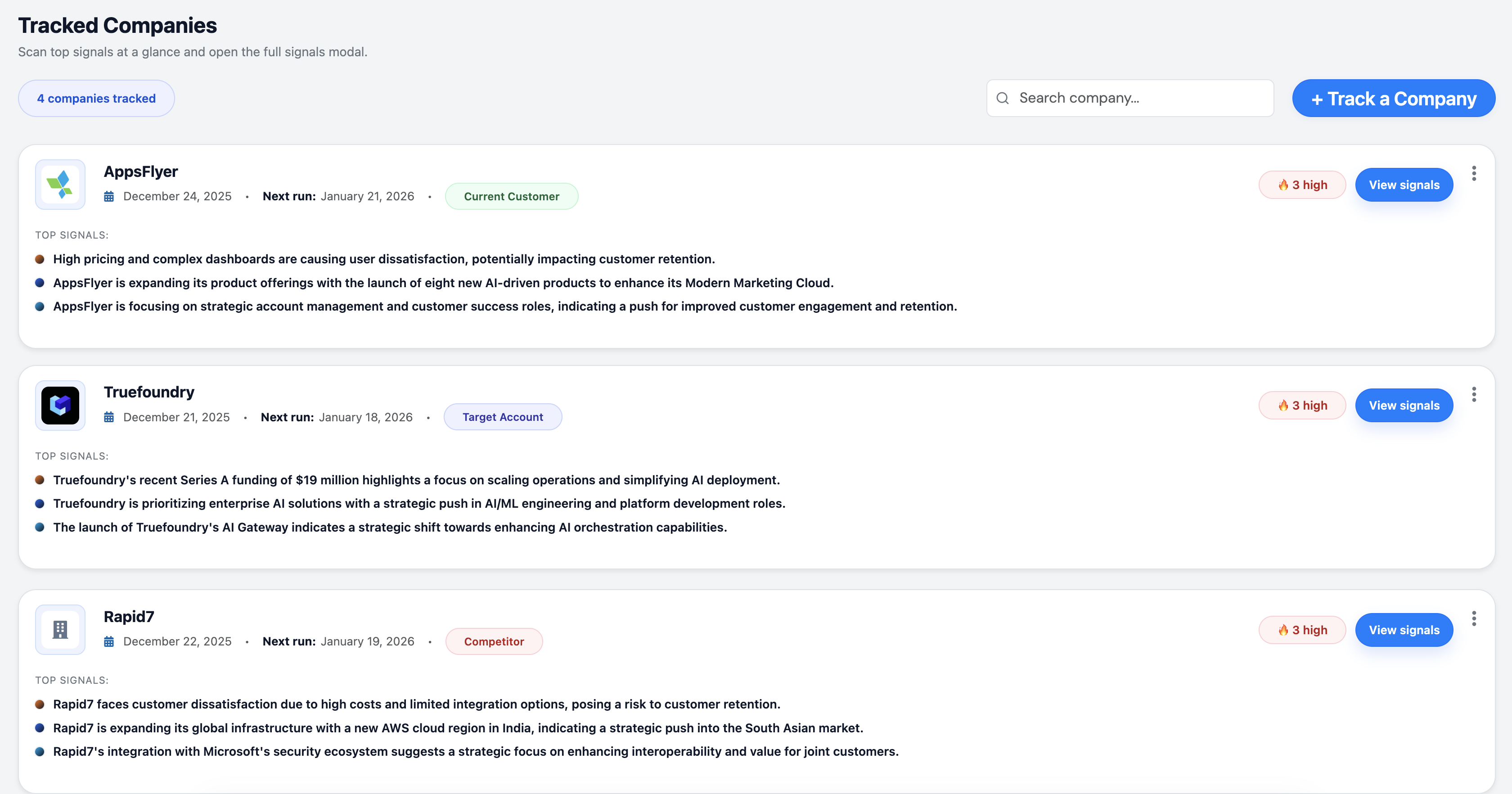
In a typical signals view, you might see:
- Recent funding
- Targeted hiring (for example, hiring 10+ enterprise AEs in North America)
- A new AI product launch or initiative
With a weekly or monthly monitoring cadence, you can keep a regular eye on your target accounts, get notified when new signals appear, and push those signals into your go-to-market stack.
Connecting signals to your ABM stack (HubSpot, ads, and automation)
Where this becomes really powerful is when you connect ConnectCurator.ai to your existing tools.
1. ConnectCurator.ai to HubSpot to ABM tools
When ConnectCurator detects new account-level signals, they can be:
- Synced directly into HubSpot
- Attached to company records or deals
- Used to trigger ABM workflows or campaigns
If you already have ABM tools integrated with HubSpot, you can create an end-to-end flow:
- ConnectCurator.ai detects an account signal (funding, hiring spike, product launch)
- The signal is pushed into HubSpot
- HubSpot triggers ABM ad campaigns, sequences, or tasks for sales
- You measure the impact on meetings, pipeline, and revenue from those accounts
This turns your ABM program into a signal-driven machine, not just a static list of accounts.
2. ConnectCurator.ai as the trigger layer with n8n
ConnectCurator can also act as the trigger layer for ABM execution through automation tools like n8n.
For example:
- ConnectCurator.ai detects a meaningful signal at a target account.
- That signal is passed into an n8n workflow.
- The workflow enriches context, sends it to messaging or creative tools, and suggests account-specific ad angles and outreach messaging.
- A human marketer or salesperson reviews and approves.
- The campaign goes live on paid channels or is used in personal outreach.
This leads to faster, more relevant ABM execution, aligned to what actually changed at the account.
Bringing it all together
Account-Based Marketing in 2026 is no longer just:
- Picking a list of big logos
- Running some generic ads
- Calling it an ABM program
Modern ABM is:
- Strategic - focused on the right accounts and buying committees
- Personalized - messaging and plays tailored to real pains and priorities
- Signal-driven - powered by up-to-date evidence of what is happening inside target accounts
- Always-on - operating as a continuous engine, not a one-off campaign
Tools like ConnectCurator.ai help you detect real signals at your target accounts earlier, trigger relevant outreach, connect insights into HubSpot and automation tools like n8n, and measure impact in meetings, opportunities, and revenue from your ABM list.
If you are serious about ABM in 2026, the question is no longer "Should we use ABM?" It is "Are we using the right signals to power it?"